
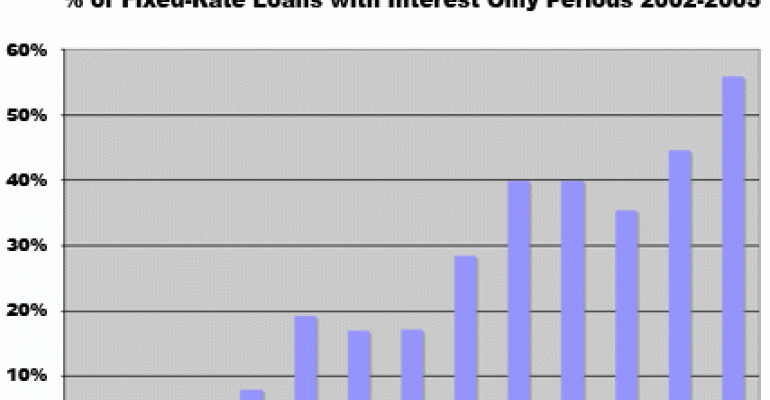
For those sniffing out possible troubles ahead for commercial real estate, add this one: The huge growth in interest-only (IO) loans over the past three years. As of January 1, 55.8% of all fixed-rate conduit loans featured IO periods—up from 5.9% at the beginning of 2002. And 35.6% of these loans are IO for the full term, according to an analysis by Moody’s Investors Service.
Why worry? Because the jump in IO loans may be a signal of loose underwriting standards and emblematic of a speculation-driven market: For a borrower who is intent on flipping assets, IOs make sense: By the time the loan requires him to pay back the principle, he’s on to another deal. As long as it’s a seller’s market, that is. If rising interest rates or other factors stop the price spiral and deal frenzy, IO buyers will be stuck. They will wind up paying the principal—if they can.
Not all IO borrowers are reckless speculators, of course. And a few IO loans wouldn’t be a problem, but frothy loan underwriting has swelled the total dollar volume to $800 billion of the total $1.7 trillion in commercial mortgage debt at year-end 2004.

Here’s another factoid for your catalog: That $1.7 trillion is a staggering 14.4% of U.S. gross domestic product. Moody’s reports that the historical average since 1970 is 11.2%. The last time that commercial mortgages accounted for more than 14.4% of the economy was during the late 1980's, and everyone knows how that ended. Frothy underwriting was responsible for the ensuing credit crunch back then. While few are expecting a similarly explosive outcome in the near future, several trends have industry sources on edge.
"The amount of capital chasing real estate today is as huge as it was in the late 1980s. But now you see cash reserves coming down and leverage going way up," says Tad Philipp, a managing director at Moody's. He believes that real estate has had a strong run over the past few years, and as a result many investors aren't factoring enough risk into their deals.
Still, loan delinquencies remain fairly low throughout the commercial real estate industry, which suggests that the capital markets have exercised some measure of discipline over the past few years. "Now would be an excellent time for the capital markets forces to begin acting,” says Philipp, who hopes that imbalances can be self-correcting.
A new report from Standard & Poor’s Ratings Services even shows that loan defaults have actually declined over the past two years. Among 29,827 rated U.S. CMBS originated between 1993 and 2002, there were only 306 defaults in 2004. In 2003, by comparison, there were 404 defaults (or 24% more).
Still, there are industry insiders who question the quality of underwriting that has produced the IO boom. “What does the guy originating the loan really care?” says a source from one of the largest loan servicers in the nation. “The borrower needs the interest-only loan to make their returns work, and it may not really be a problem for years. This is an extremely competitive business.”