
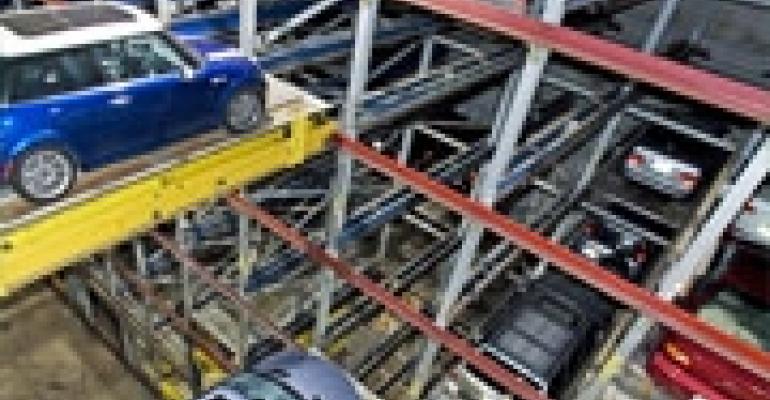

In cities across the country, as high-density residential, retail and office developments pop up to meet consumers’ demand for an urban lifestyle, developers have found parking in short supply, since available land is scarce and expensive.
To meet the need for urban parking, many developers are offering automated garages, which rely on computer-run robotic systems. These garages can accommodate two to three times more parking than their conventional ramp-access counterparts, and can be built above or below ground.
“I think [the automated format] is going to be booming in the next three to five years,” says Don Monahan, vice president of Walker Parking Consultants in Greenwood Village, Colo. High-tech garages have been a fixture in Europe for decades, and Monahan and other experts anticipate that they will become popular in the U.S.
Here’s how it works: A driver pulls a vehicle into an entry room about the size of a one-car garage. Positioned on a pallet, the vehicle is measured by sensors and the space is scanned to ensure that no people or animals remain behind. A mechanical system then moves the unoccupied vehicle to a parking vault and tucks it into a computer-chosen slot. Later, the motorist runs a ticket or card through an electronic reader, and the car automatically is transported to the exit room.
Several automated parking projects are underway around the country. For example, APT Parking Technologies of New York and Westfalia Technologies Inc. of York, Pa., are working on a 300-space garage for the $200 million Lovejoy Wharf mixed-use development being built along the Boston waterfront. They are also working on a 270-car garage for a nine-story, 226,000 sq. ft. office building under construction in Brooklyn, N.Y.
Parking technology provider Unitronics, based in Israel with a U.S. headquarters in Quincy, Mass., is undertaking two projects on the East Coast. And Automotion Parking Systems, a parking provider based in West Hempstead, N.Y., plans an automated garage with about 70 spaces in conjunction with a 17-story residential tower in Manhattan.
Automated parking typically costs $20,000 to $35,000 per space, Monahan says, while underground ramp-access parking ranges from $20,000 to $30,000 per space, and above-ground structured parking runs about $15,000 per space.
Although the price tag for an automated garage can be higher than for a traditional garage, experts point out that the high-tech version offers several advantages. More parking stalls can be shoehorned into a smaller space in an automated garage, raising parking revenue.
Structured parking consumes roughly 340 sq. ft. per space, compared with about 180 sq. ft. per space in an automated garage, says Martin Mattia, product manager at FATA Automation Inc., a Sterling Heights, Mich.-based provider of parking technology.
Another benefit: Under an automated scenario, space that had been allocated for traditional parking can be freed up for condos, apartments, hotel rooms or offices, all of which generate higher revenue than garage.
Furthermore, compared with conventional parking, automated garages are “greener” since they require less lighting and no ventilation, and cut down on vehicle emissions, because the engine isn’t running while a car rides through an automated system.
“This type of system is the better mouse trap,” says Ari Milstein, director of planning at Automotion.
Parking executives say automated garages also provide a safer environment, since they bar public access to car storage areas. But Rafi Stoffman, vice president of sales and marketing at Unitronics notes that real estate developers are less concerned about security and more concerned about their expenses.
Earlier this year, Unitronics finished retrofitting a 314-space automated garage in Hoboken, N.J., that had been plagued by political, legal and operational snags. Unitronics wasn’t involved with the garage until after city leaders shut it down in 2006, when it was hired to help resolve the technical problems.
Among the issues since the garage opened in 2002: Two unoccupied vehicles plummeted several stories, and a 26-hour technical glitch imprisoned all the cars.
The Hoboken fiasco dealt a serious setback to the automated parking business in the United States, industry executives say. But with the garage fixed — and with land at a premium in densely populated cities like New York and Chicago — supporters of automated parking expect the Hoboken incident to fade away.
“The long-term outlook is good,” Milstein says. “A lot of the knee-jerk reaction of fear is starting to dissipate.”
Marty Stein, president of the National Parking Association, doubts that automated garages will eclipse traditional garages. “[The automated format] has gained acceptance as a viable option for particular parking challenges,” he says. “I see it continuing to grow.”